
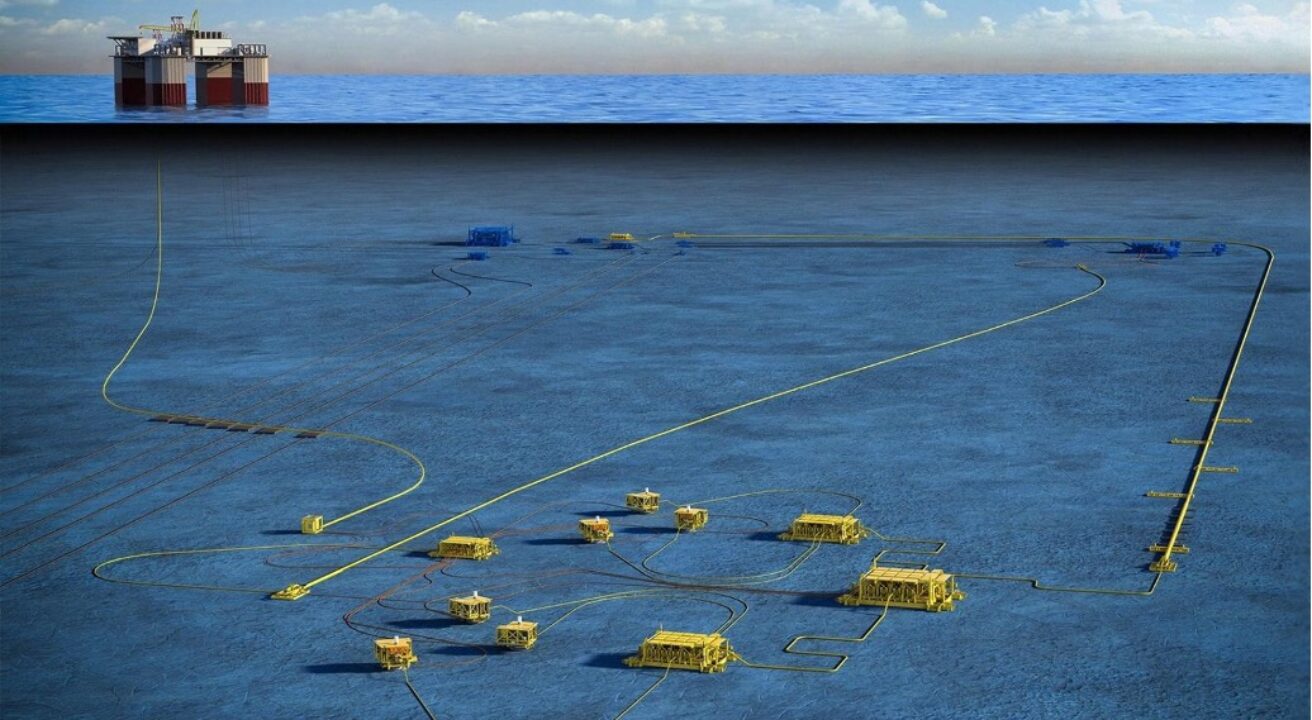
The project entails connecting fields at water depths of 1200-1350m using a 35 km long, 24-inch pipeline of CRA and Carbon Steel. SEA Global completed Concept and Pre-FEED engineering, applying automated scientific programming and advanced optimization systems.
The work included evaluating comprehensive field architectures, performing detailed transient and steady-state thermohydraulic flow assurance modeling for sizing, and designing subsea components like trees, spools, and manifolds across varying contracting strategies. The scope further covered routing, thickness design, cathodic protection assessments, on-bottom stability/roughness tasks, Top of Line and Bottom of Line corrosion modeling, 3D global buckling/walking models, and an Engineering Critical Assessment (ECA) to prevent onerous installation welding constraints.
Water Depth
1200-1350m
Drill Centre
6 trees, dual manifolds, subsea to subsea pigging, future expansion
Pipeline Length
35 km
Pipeline Diameter
24-inch CRA and Carbon Steel
Design Pressure
28.4 MPa
Scope of Work
Concept Development & Strategy
Created, optimised and compared a wide range of development options to identify best concept for GS3, including field architecture and detailed engineering to demonstrate performance and identify key contract strategies.
Integrated Production Modelling, Flow Assurance & Line Sizing
Integrated production modelling was performed to identify the best performing development scenarios using detailed steady state and transient thermohydraulic modelling. This enabled system performance to be optimised and to define mechanical design inputs.
Subsea architecture
The subsea architecture (including power, controls, trees, spools and manifolds) was designed and optimised across a range of vendor contracting strategies and for a specific vendor and installation contractor capabilities.
Mechanical Design
Application of automated scientific programming techniques across all mechanical design tasks for multiple combinations of well count, line size and development scenarios. Scope included routing, wall thickness, coatings, cathodic protection, on-bottom stability and on-bottom roughness.
Material Selection
Detailed Top of Line (TOL) and Bottom of Line (BOL) corrosion modelling based on Integrated Production Modelling (IPM) forecasting across a range of reservoir outcomes identified significant reductions in CAPEX through materials selection and coating configuration, and as input to system architecture.
Buckling, Walking & ECA
3D whole system global buckling and walking models were used to determine the buckle initiation strategy and understand axial walking, suitable strategy to manage global buckling. An engineering critical assessment (ECA) was also performed to demonstrate fracture would not impose onerous welding constraints for installation contractors.
More Case Studies

Join the unparalleled.
If you’re ready to create a more efficient, sustainable and intelligent world…
Contact SEA Global